In Puerto Rico, only 20% of what we consume comes from what is produced on the island, the rest is imported. If we take this situation to the islands of Vieques and Culebra, the panorama worsens, since they depend on what reaches Puerto Rico or is caught on the big island, arriving by boat.
For this reason, and for much more, the Fishermen's Association has worked for the Villa Pesquera de Culebra, which was founded around 1963, when the population of this island was around 500 people. For the inhabitants of Culebra, Villa Pesquera is essential. In this space, not only is a sustainable economy generated, but its members have a place where they can exchange ideas and knowledge, as well as sell products or even have tools that ensure their safety. The vision of this Association is to self-manage the fishing sector of Culebra to promote the viability and resilience of small-scale fisheries, and thus enhance community well-being and economic sustenance.
The Culebra Fishing Village began to transform some time ago. While continuing the legacy of the historic association, the new fishermen's organization (Asociación Pesquera de Culebra Inc.) faces new opportunities for adaptation and innovation. Nowadays, the fishing is a bit behind since there are not as many fishermen as there used to be. This space, on the island of Culebra, is of great value because it is where proposals are carried out that seek to promote and continue the legacy of fishing, while promoting its preservation. And although both themes seem antagonistic, they are not.
As Nicolás Gómez, who is the secretary of the Culebra Fishing Association, told us, “This town was a pioneer in proposing the first no-fishing reserve proposed by fishermen. It means that the Fishermen's Association has an environmental conscience and recognizes that the country must be protected, in this case through sustainable fishing and the protection of reefs. Apart from the cultural value, there was an environmental one, a conscience”.
Entering the 2000s, Villa Pesquera collapsed. Nicolás, the son of a commercial fisherman, saw that decline and grew up with that abandoned space. His love for the sea led him to study environmental sciences and that is when he began to get involved and become aware of the problems, especially on a rural island where there are multiple situations that affect the day-to-day life there. It is for this reason that he began to identify the needs, this includes putting fishermen as the central axis, who support the restoration of corals and who can provide fish and shellfish to their population, especially when food does not arrive or when the Costs are very high for this population.
To continue betting on what he is passionate about and his island, Nicolás did a master's degree in Fisheries Management, and investigated how fishermen collaborate with each other. Nicolás told us that "fishermen who are associated have advantages and social capital over those who operate on their own." After meeting, he validates the need of the fishermen and different sectors of the Culebrense community. It was through these meetings that they realized that this group is needed and to rescue Villa Pesquera as an essential place for the Culebra community.
Nicolás clarifies that “we must create a difference between industrial fishing and ours. In the industry you find large fleets that fish thousands of tons that destroy the sea and have unsustainable practices where they even catch other incidental animals. These profits do not go to the communities. Our fishing is small-scale and, in some cases, even artisanal. Also, the equipment is sometimes made in houses. The volume is relatively small, so we don't necessarily see it in supermarkets. It is a more manageable type of fishing and that is why situations can be addressed. In Puerto Rico we import almost 80% of what is consumed. In Culebra it is the same or more, what we do not catch or do on the island, they have to bring it from abroad. There is a lot of demand, fish that is fresh and nutritious is in demand. There is a social need."
In Culebra, according to Nicolás, fishermen are in the minority, there is not a generation that is continuing this viability of the commercial sector and that is resilient. It is for this reason that the Fishermen's Association has taken on the task of creating an educational learning program for commercial fishing, so that they learn about regulations and are trained in different types of fishing. In the same way, this type of education provides them with spaces to do other types of marine technical work.
"We are training marine workers who know and can take on this type of work. Culebra's community sector is strong; there are microenterprises, agriculture and music, among others. That is why we have organized ourselves and created good practices with community awareness. We are collaborative and hold meetings and workshops. It is no longer a hierarchy where people say what needs to be done: now the dynamic is that everyone collaborates, which helps keep the Fishing Village together," said Nicolás.
Apart from the educational program, there are other projects that focus on the Fishing Village. As there is no fish market or public dock, there is no infrastructure, so without having a process that complies with the rules, fishing cannot be encouraged. "We have rebuilt the entire roof of the Fishing Village with community collaboration, and we are working to make it a sustainable model. The Village is a place for fish processing; it has professional facilities that comply with sanitation regulations. It also allows us to identify species, to quantify what is being fished and supply statistics to the agencies that need them," said Tomás Ayala Feliciano, president of the Fishermen's Association.
Popular, through the Business Acceleration Program, has helped make the Fishing Village a community space where knowledge is strengthened, as well as the economy of those who work in this sector. In addition, through contributions, it has been able to acquire equipment for the fish market. Nicolás tells us that "instead of selling fish on the street, we have a fish market there to sell from. This allows us to sell not only to restaurants, but also to families. The fish market can set fairer prices. Popular helps with the equipment and design, so that we may comply with regulations and at the same time be a place where the community can buy fish at good prices.”
In other areas where Popular has been instrumental, safety has been one of the main focuses of the Fishing Village. Through the donation, the Village was able to acquire equipment that alerts the Coast Guard in case their boat sinks. Ten fishermen have benefited from this equipment.
At the same time, FAD (Fish Aggregating Device) buoys were acquired and financed by Popular. These buoys attract pelagic fish such as tuna, dorado and other species that migrate and are not found in one place. These buoys attract these types of fish and make them easier to catch. It is important to have a diversity of fishing spots and not always fish from the same places.
Without electricity, it is difficult to keep these types of products refrigerated. Popular has supported solar energy, which is another objective of the Fishermen's Association. Today, the Village runs 100% on solar energy. Popular supported part of this project that had already begun, but it required more capital to be 100% energy self-sufficient.
"For now, our focus is to continue to train and educate a new generation of Culebrense fishermen, provide high quality local fish and seafood, promote nautical education, and steward marine ecosystems for local environmental sustainability," said Tomás.
The multiple proposals of this Association do not end there; their ambition to achieve much more is palpable. "We have festivals to remember and keep the memory of the fishermen before us. We have a multipurpose space where we meet, and plan to have an interactive museum on the walls where we will have aquariums, live lobsters, and information so that everyone who visits us can learn about ecosystems and fishing in general," concluded Nicolás.
Fishing, like other microenterprises, is fundamental to the growth and sustainability of Puerto Rico's economy. These types of spaces allow many people to benefit and Popular, through the Business Acceleration Program, is fundamental in this process. Here's too more spaces like the Culebra Fishing Village.
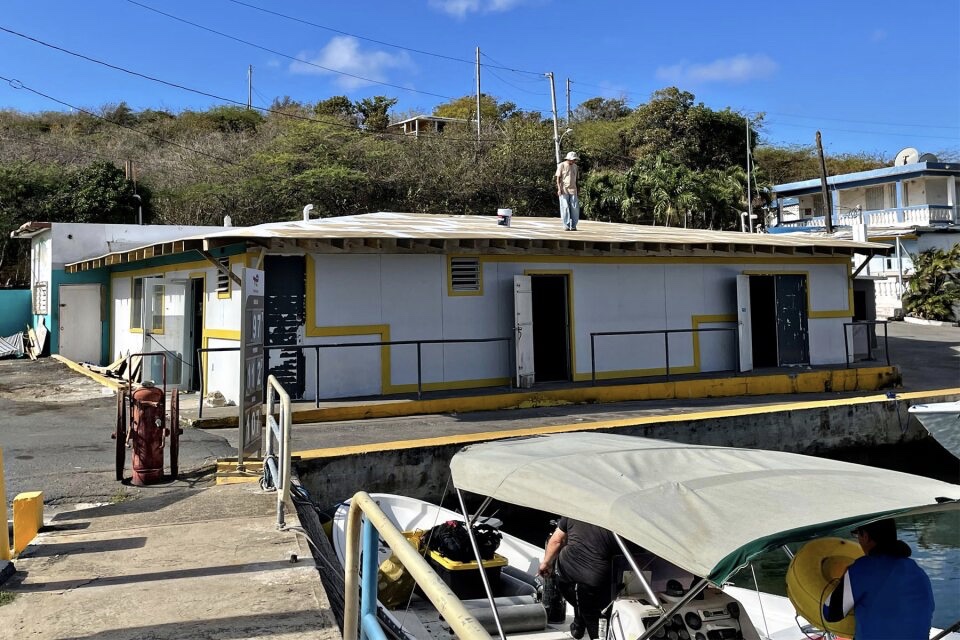
Fishing village in Culebra.
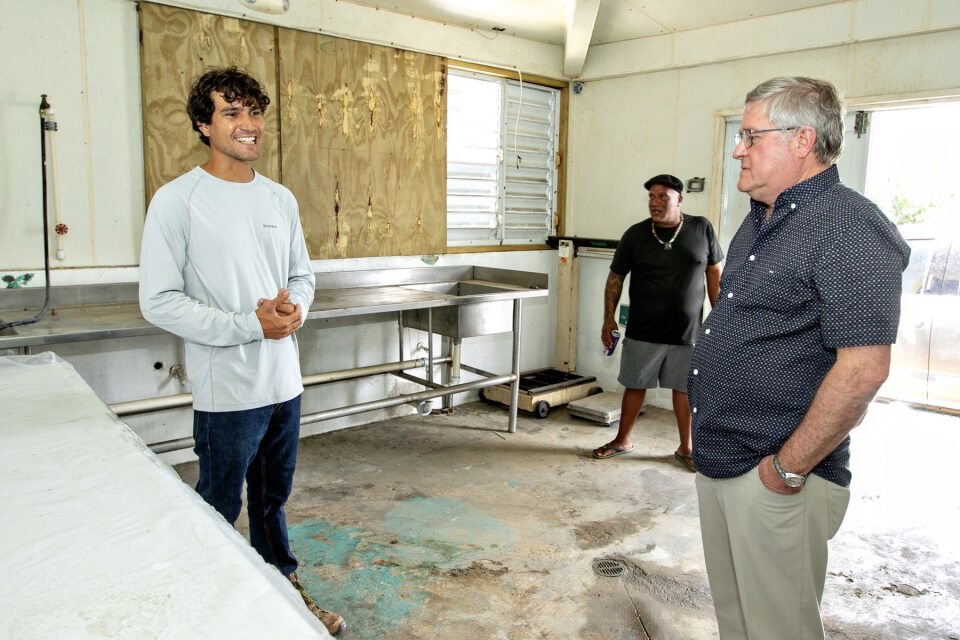
Culebra’s Fishermen Association secretary Nicolás Gómez (right), talks with Culebra’s Fishermen Association president Tomás Ayala Feliciano (center) and Popular, Inc.’s CEO Ignacio Alvarez (left) during a recent visit